About of Adolescent Mothers Will Become Pregnant Again Within Two Years
Why Focus on Teen Pregnancy?
Virtually all of the growth of single-parent families in recent decades has been driven past an increment in births outside spousal relationship. Divorce rates have leveled off or declined modestly since the early 1980s and thus have non contributed to the rising proportion of children being raised by just one parent nor to the increase in child poverty and welfare dependence associated with the rising in single-parent families.
Not all non-marital births are to teen-agers. In fact, 70 pct of all births outside spousal relationship are to women over age 20. For this reason, some argue that a focus on teens fails to address the real problem and that much more attention needs to be given to preventing childbearing, or raising wedlock rates, among unmarried women who have already entered their adult years.
But in that location are at to the lowest degree 4 reasons to focus on teens:
Outset, although a large proportion of non-marital births is to adult women, half of starting time not-marital births are to teens. Thus, the pattern tends to start in the teenage years, and, once teens take had a get-go child outside marriage, many go along to accept additional children out of wedlock at an older historic period. A number of programs aimed at preventing subsequent births to teen mothers take been launched but few have had much success. So, if we want to prevent out-of-wedlock childbearing and the growth of single-parent families, the teenage years are a good place to start
Second, teen childbearing is very plush. A 1997 study past Rebecca Maynard of Mathematica Policy Research in Princeton, New Jersey, found that, after decision-making for differences between teen mothers and mothers aged twenty or 21 when they had their first child, teen childbearing costs taxpayers more than $vii billion a twelvemonth or $3,200 a year for each teenage nativity, conservatively estimated.
Third, although nigh all single mothers face major challenges in raising their children alone, teen mothers are especially disadvantaged. They are more than likely to have dropped out of schoolhouse and are less likely to be able to back up themselves. Only one out of every five teen mothers receives any support from their child's father, and about lxxx percent end upward on welfare. Once on welfare, they are likely to remain there for a long fourth dimension. In fact, half of all electric current welfare recipients had their showtime child as a teenager.
Some enquiry suggests that women who accept children at an early age are no worse off than comparable women who filibuster childbearing. According to this research, many of the disadvantages accruing to early on childbearers are related to their own disadvantaged backgrounds. This enquiry suggests that it would be unwise to attribute all of the problems faced by teen mothers to the timing of the birth per se. Merely fifty-fifty after taking background characteristics into account, other research documents that teen mothers are less probable to finish loftier school, less likely to ever ally, and more than probable to have additional children outside marriage. Thus, an early on birth is not just a marker of preexisting problems but a bulwark to subsequent up mobility. As Daniel Lichter of Ohio State University has shown, even those unwed mothers who eventually ally end upwardly with less successful partners than those who delay childbearing. Every bit a event, fifty-fifty if married, these women face much higher rates of poverty and dependence on government assistance than those who avert an early nascency. And early on marriages are much more likely to cease in divorce. So marriage, while helpful, is no panacea.
Fourth, the children of teen mothers confront far greater bug than those born to older mothers. If the reason nosotros care about stemming the growth of single-parent families is the consequences for children, and if the age of the mother is every bit of import as her marital status, then focusing solely on marital status would be unwise. Not simply are mothers who defer childbearing more likely to marry, simply with or without matrimony, their children will be meliorate off. The children of teen mothers are more likely than the children of older mothers to exist born prematurely at low birth weight and to suffer a variety of health problems equally a consequence. They are more probable to do poorly in school, to suffer college rates of corruption and fail, and to finish upwardly in foster care with all its attendant costs.
How Does Current Welfare Law Address Teen Pregnancy and Non-Marital Births?
The welfare constabulary enacted in 1996 independent numerous provisions designed to reduce teen or out-of-union childbearing including:
- A $l one thousand thousand a year federal investment in forbearance educational activity;
- A requirement that teen mothers complete loftier schoolhouse or the equivalent and live at home or in another supervised setting;
- New measures to ensure that paternity is established and child back up paid;
- A $twenty million bonus for each of the 5 states with the greatest success in reducing out-of-wedlock births and abortions;
- A $1 billion performance bonus tied to the police force'southward goals, which include reducing out-of-matrimony pregnancies and encouraging the formation and maintenance of two-parent families;
- The flexibility for states to deny benefits to teen mothers or to mothers who have boosted children while on welfare (no land has adopted the offset simply 23 states accept adopted the 2d); and
- A requirement that states set goals and take actions to reduce out-of-wedlock pregnancies, with special emphasis on teen pregnancies.
Inquiry attempting to establish a link betwixt i or more than of these provisions and teen out-of-wedlock childbearing has, for the most part, failed to notice a clear relationship. One exception is child support enforcement, which appears to take had a meaning upshot in deterring unwed childbearing.
Are Teen Pregnancies and Births Failing?
Teen pregnancy and birthrates have both declined sharply in the 1990s (figure i). The fact that these declines predated the enactment of federal welfare reform suggests that they were acquired by other factors. Yet, it is worth noting that many states began to reform their welfare systems earlier in the decade under waivers from the federal authorities, and then we cannot be sure. In addition, the declines appear to take accelerated in the 2nd half of the decade after welfare reform was enacted. And finally, about of the pass up in the early 1990s was the result of a subtract in 2nd or college lodge births to women who were already teen mothers. This decrease was related in role to the popularity of new and more effective methods of nascence command among this group. It was not until the second half of the decade that a meaning drop in start births to teens occurred.
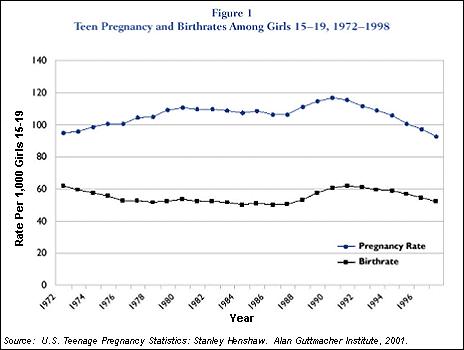
Teen birthrates had as well declined in the 1970s and early 1980s but in this earlier period all of the turn down was due to increased abortion. Significantly, all of the teen birthrate decreases in the 1990s were due to fewer pregnancies, not more abortions.
Equally significant is the fact that teens are at present having less sex. Up until the 1990s, despite some progress in convincing teens to apply contraception, teen pregnancy rates continued to ascent because an increasing number of teens were becoming sexually active at an early on age, thereby putting themselves at adventure of pregnancy. More recently, both amend contraceptive use and less sex have contributed to the lowering of rates.
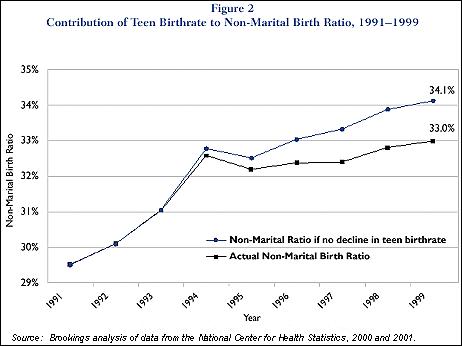
Given that four out of 5 teen births are to an unwed female parent, this drop in the teen birthrate contributed to the leveling off of the proportion of children built-in outside marriage after 1994 (figure 2). More than specifically, if teen birthrates had held at the levels reached in the early 1990s, by 1999 this proportion would take been more than a full percentage bespeak college. Thus, a focus on teenagers has a major part to play in future reductions of both out-of-marriage childbearing and the growth of single-parent families.
What Acquired the Decline in Teen Pregnancies and Births?
Although the firsthand causes of the pass up-less sexual activity and more than contraception-are relatively well established, it is less clear what might have motivated teens to choose either ane. Even so, many experts believe information technology was some combination of greater public and private efforts to prevent teen pregnancy, the new messages nigh piece of work and child back up embedded in welfare reform, more bourgeois attitudes among the young, fear of AIDS and other sexually transmitted diseases, the availability of more effective forms of contraception, and perhaps the stiff economy.
Some of these factors have undoubtedly interacted, making it difficult to ever sort out their separate furnishings. For case, fear of AIDS may accept made teenagers-males in particular, for whom pregnancy has traditionally been of less concern-more cautious and willing to listen to new messages. Indeed, as shown by Leighton Ku and his colleagues at the Urban Plant in Washington, D.C., the proportion of adolescent males blessing of premarital sex decreased from fourscore per centum in 1988 to 71 pct in 1995. The Ku study as well linked this shift in boyish male person attitudes to a alter in their behavior.
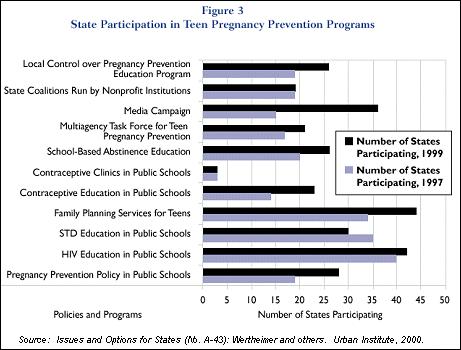
The growth of public and private efforts to combat teen pregnancy may have too played a role, as suggested past surveys conducted past the National Governors' Clan, the General Accounting Role, the American Public Homo Services Association, and most recently and comprehensively, by Kid Trends. The Child Trends study, conducted past Richard Wertheimer and his associates at the Urban Plant, surveyed all 50 states in both 1997 and 1999. The survey shows that states have dramatically increased their efforts to reduce teen pregnancy (figure three). These efforts include everything from the formation of statewide task forces to more accent on sex activity teaching in the public schools and statewide media campaigns. Although such efforts accept been profoundly expanded in recent years, they are still relatively small. State spending on teen pregnancy prevention averages only about $eight a year per teenaged girl. In add-on to being minor, such efforts may or may not be effective in preventing pregnancy. Fortunately, we know more than about this topic at present than we did even a few years ago.
Do Teen Pregnancy Prevention Programs Work?
The curt respond is "yes, some do." Based on a careful review of the scholarly literature completed by Douglas Kirby of ETR Associates in Santa Cruz, California, a number of rigorously evaluated programs have been found to reduce pregnancy rates. Two of these programs have reduced rates by as much as half. One is a program that involves teens in customs service with adult supervision and counseling. The other includes a range of services such equally tutoring and career counseling along with sexual practice education and reproductive health services. Both take been replicated in various communities and evaluated past randomly assigning teens to a program and command grouping. In add-on, a number of less intensive and less costly sex didactics programs have besides been found to be effective in persuading teens to delay sex activity and/or use contraception. Such programs typically provide clear messages most the importance of abstaining from sex activity and/or using contraception, teach teens how to deal with peer pressure to take sex, and provide practice in communicating and negotiating with partners.
"Forbearance just" programs are relatively new and take not yet been discipline to conscientious evaluation, although what enquiry exists has not been encouraging. More importantly, the line between abstinence only and more comprehensive sex instruction that advocates abstinence simply also teaches about contraception is increasingly blurred. What matters is not so much the label but rather what a item program includes, what the teacher believes, and how that plays out in the classroom. A strong forbearance message is totally consistent with public values, but the idea that the federal authorities tin can, or should, rigidly prescribe what goes on in the classroom through detailed curricular guidelines makes picayune sense. Family and customs values, non a federal mandate, should prevail, specially in an expanse as sensitive as this one.
Exercise Media Campaigns Work?
Community-based programs are only office of the solution to teen pregnancy. Indeed, but 10 percent of teens report they have participated in such a plan (outside of school), while on average teens spend more than 38 hours a week exposed to diverse forms of entertainment media. Past themselves, teen pregnancy prevention programs cannot alter prevailing social norms or attitudes that influence teen sexual behavior. The increase in teen pregnancy rates between the early on 1970s and 1990 was largely the result of a change in attitudes about the appropriateness of early premarital sex activity, specially for young women. As more and more teen girls put themselves at risk of an early pregnancy, pregnancy rates rose. More than recently, efforts to encourage teens to take a pledge not to have sex before wedlock have had some success in delaying the onset of sex.
In an attempt to influence these attitudes and behaviors, several national organizations as well equally numerous states have turned to the media for assistance. Between 1997 and 1999 alone, the number of states conducting media campaigns increased from 15 to 36. Typically, such campaigns use both print and electronic media to achieve large numbers of immature people with messages designed to modify their behavior. Such messages can be delivered via public service announcements (PSAs) or past working with the media to comprise more responsible content into their ongoing programming. About state efforts rely on PSA campaigns but several national organizations are working with the entertainment industry to bear upon content.
Enquiry assessing the effectiveness of media campaigns is less extensive and less widely known than research evaluating community-based programs, just it shows that they, also, can be effective. A meta-analysis of 48 different wellness-related media campaigns from smoking cessation to AIDS prevention by Leslie Snyder of the University of Connecticut found that, on boilerplate, such campaigns acquired seven to 10 pct of those exposed to the campaign to alter their behavior (relative to those in a command group). Equally with community-based programs, media campaigns vary enormously in their effectiveness and need to be designed with care. But existing evidence suggests that they are a expert way to attain large numbers of teens inexpensively.
Are Efforts to Reduce Teen Pregnancy Cost-Effective?
At kickoff advent, the finding by Rebecca Maynard that each teen mother costs the government an average of $3,200 per year suggests that government could spend as much every bit $3,200 per teen girl on teen pregnancy prevention and break even in the process. Simply, of course, not all girls become teen mothers and programs addressing this problem are not 100 pct constructive so a lot of this coin would be wasted on girls who exercise not need services and on programs that are less than fully effective.
Here is a simple only useful method to estimate how much money could be spent on teen pregnancy prevention programs and still realize benefits that exceed costs. If we take Maynard's guess that reducing teen pregnancy saves $3,200 per birth prevented (in 2001 dollars), the question is how much should nosotros spend to prevent such births? Nosotros kickoff have to adjust the $3,200 estimate for the fact that not all teen girls will go significant and give birth without the intervention programme. We know that about 40 per centum of teen girls go significant and about one-half of these (or 20 percentage) give birth. This adjustment yields the approximate that $640 (20 percent multiplied by $three,200) might be saved by a universal prevention program. (If we knew how to target the immature people most at take chances we could salve even more than this.) All the same, a second aligning is necessary because not all intervention programs are effective. Based on data reviewed by Douglas Kirby and by Leslie Snyder, a skillful estimate is that near one out of every ten girls enrolled in a programme or reached by a media campaign might change her behavior in a way that delayed pregnancy beyond her teen years. This 2d adjustment yields the approximate that universal programs would produce a benefit of 10 per centum of $640 or well-nigh $64 per participant. Equally the Wertheimer survey showed, actual spending on teen pregnancy prevention programs in the entire nation now averages about $8 per teenage girl. If the potential savings are $64 per teenage female person while actual current spending is merely $8 per teenage female, authorities is clearly missing an opportunity for productive investments in prevention programs. In fact, these calculations-while rough-propose that government could spend upwardly to eight times ($64 divided past $viii) as much every bit is currently being spent and still pause even.
Implications for Welfare Reform Reauthorization Research and experience over the concluding decade suggest several lessons for the administration and Congress equally they consider reauthorization of the 1996 welfare reform legislation.
First, the emphasis in the current law on fourth dimension limits, work, and child support enforcement should be maintained. The 1996 welfare reform police force included a fix of very important messages. To young women, it said "if yous get a mother, this will not relieve you of an obligation to end school and support yourself and your family unit through work or marriage. And any special assistance you receive volition be time limited." To young men, it said "if you male parent a child out-of-marriage, you will be responsible for supporting that child." Although opinions vary as to whether these messages have had an impact, in my view the decline in teen pregnancies and births together with the leveling off of the non-marital birth ratio and of the proportion of children living in single parent homes all suggest such an touch. These messages may exist far more important than any specific provisions aimed at increasing union or reducing out-of-wedlock childbearing, and their effects are likely to cumulate over time.
Second, the federal authorities should fund a national resource center to collect and disseminate information about what works to forbid teen pregnancy. Until recently, petty information was available about the best ways to prevent teen pregnancy. States and communities had no way of learning nearly each other's efforts and teens themselves had no ready source of information virtually the risks of pregnancy and the consequences of early unprotected sex. Some private organizations have attempted to fill up the gap without much help from public sources.
3rd, Congress should send a stiff forbearance message coupled with education near contraception. Surveys of both adults and teens reveal potent support for abstinence as the preferred standard of beliefs for schoolhouse-age youth, and they want teens to hear this bulletin. At the same fourth dimension, a majority is in favor of making nascence control services and information available to teens who are sexually agile. In addition, few await all single adults in their twenties to abstain from sexual practice until marriage. And since a big proportion of non-marital births occurs in this age group, and a significant number of teens go on to be sexually agile, instruction most and access to reproductive health services remains important through Title X of the Public Health Service Act, the Medicaid program, and other federal and country programs.
Fourth, adequate resource should be provided to states to prevent teen pregnancy, without specifying the ways for achieving this goal. In addition, states that work successfully to reduce teen pregnancy should be rewarded for their efforts. A strong argument can be made that the federal government should specify the outcomes it wants to achieve but non prescribe the means for achieving them. This is especially important given some uncertainty about the effectiveness of different programs and strategies, and the diverseness of opinion near the best way to proceed. It suggests the wisdom of retaining a block grant structure for TANF and avoiding earmarks for specific programs. This does not mean the federal government should not reward states that reach sure objectives, such equally an increase in the proportion of children living in ii-parent families, a decline in the non-marital birth ratio, or a decline in the teen pregnancy or birth charge per unit. Reducing early childbearing may be 1 of the virtually effective ways of increasing the proportion of children built-in to, and raised by, a married couple. Just states should determine on the best style to attain these outcomes, discipline only to the caveat that they base their efforts on reliable evidence most what works. The show presented above suggests that states should exist spending roughly eight times as much as they are now on teen pregnancy prevention.
Fifth, the federal government should fund a national media campaign. Too many public officials and community leaders take assumed that if they could but find the right program, teen pregnancy rates would be reduced. Although in that location are at present a number of programs that accept proved effective, the brunt of reducing teen pregnancy should non rest on programs lone. Rather, we should build on the fledgling efforts undertaken at the land and national level over the past 5 years to fund a broad-based, sophisticated media campaign to reduce teen pregnancy. These funds should back up not only public service ads but likewise various nongovernmental efforts to work in partnership with the entertainment industry to promote more responsible content. These media efforts tin can work in tandem with constructive sexual activity teaching and more expensive and intensive community level programs targeted to loftier-run a risk youth.
Decision
These steps have the potential to maintain the progress made over the past decade in reducing teen and out-of-marriage pregnancies. There are only two solutions to the problem of childbearing outside marriage. One is to encourage early on marriage. The other is to encourage delayed childbearing until wedlock. Although commonplace as recently as the 1950s, early marriage is no longer a sensible strategy in a society where decent jobs increasingly require a loftier level of education and where half of teen marriages stop in divorce. If nosotros want to ensure that more than children grow up in stable two-parent families, we must first ensure that more women reach adulthood before they take children.
Additional Reading
Henshaw, Stanley. 2001. U.S. Teenage Pregnancy Statistics. New York: Alan Guttmacher Institute.
Kirby, Douglas. 2001. Emerging Answers: Research Findings on Programs to Reduce Teen Pregnancy. Washington, D.C.: National Campaign to Forbid Teen Pregnancy.
Ku, Leighton, and others. 1998. "Agreement Changes in Sexual Activity Amongst Young Metropolitan Men: 1979-1995." Family unit Planning Perspectives, xxx(half-dozen): 256-262.
Lichter, Daniel T., Deborah Roempke Graefe, and J. Brian Brown. 2001. Is Marriage a Panacea? Marriage Formation Among Economically Disadvantaged Unwed Mothers. Columbus: Ohio State University.
Maynard, Rebecca A., ed. 1997. Kids Having Kids: Economic Costs and Social Consequences of Teen Pregnancy. Washington, D.C.: Urban Institute.
National Campaign to Prevent Teen Pregnancy. 2001. Halfway There: A Prescription for Continued Progress in Preventing Teen Pregnancy. Washington, D.C..
National Center for Health Statistics. 2000 and 2001. National Vital Statistics Reports, 48 and 49, various problems. Hyattsville, Medico.: Section of Health and Man Services.
Sawhill, Isabel. Forthcoming. "Welfare Reform and the Marriage Movement." Public Interest.
Snyder, Leslie B. 2000. "How Constructive Are Mediated Wellness Campaigns?" In Public Communication Campaign, edited by Ronald E. Rice and Charles K. Atkin. Thousand Oaks, Calif.: Sage.
Wertheimer, Richard, Justin Jager, and Kristin Anderson Moore. 2000. "Land Policy Initiatives for Reducing Teen and Adult Non-Marital Childbearing." New Federalism: Problems and Options for States (No. A-43). Washington, D.C.: Urban Found.
deeseexierfirs1964.blogspot.com
Source: https://www.brookings.edu/research/what-can-be-done-to-reduce-teen-pregnancy-and-out-of-wedlock-births/
0 Response to "About of Adolescent Mothers Will Become Pregnant Again Within Two Years"
Post a Comment