what to check for looking at sperm at home microscope
Why exercise we need biological stains for microscope?
Many biological specimens are most transparent and have very little contrast betwixt the object and the surroundings. These kinds of specimens are hard to come across nether a regular microscope.
Staining is the most common technique to enhance the visibility of your specimens by increasing the contrast. Stains or dyes can bind to certain types of components of the specimen past their chemical nature, resulting in highlighting these biological structures to stand up out of the background.
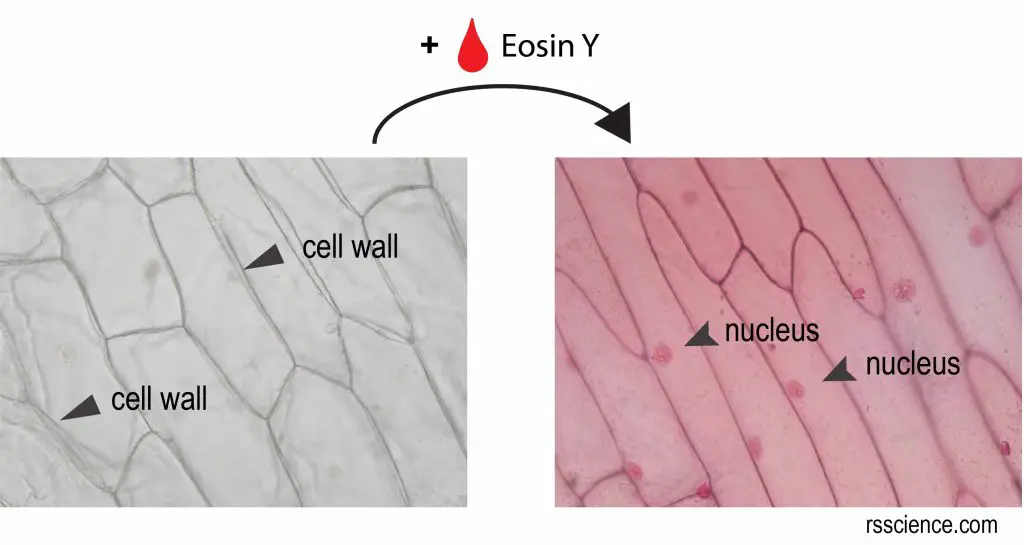
[In this figure] An example of using stains to visualize transparent specimens.
You tin easily skin off a slice of onion pare. Notwithstanding, the skin tissue is quite transparent so y'all tin only see the wells (or cells) separated by cell walls. With quick and piece of cake staining of Eosin Y, the nuclei are now visible.
What tin can biological stains do?
Biological staining is an fine art of science. There are thousands of chemic stains and dyes that have been studied by the scientists to label specific components, for instance, organelles (similar nucleus and mitochondria), biological molecules (like sugar, lipid, protein, or DNA), and microorganisms (like Gram stains for bacteria).
More advanced techniques like antibody-based immunofluorescent staining (IF) and nucleotide-based fluorescence in situ hybridization (FISH) can get even deeper and distinguish one specific poly peptide from thousands of other proteins (IF) or one unique Dna code from an unlimited combination of possibility (FISH).
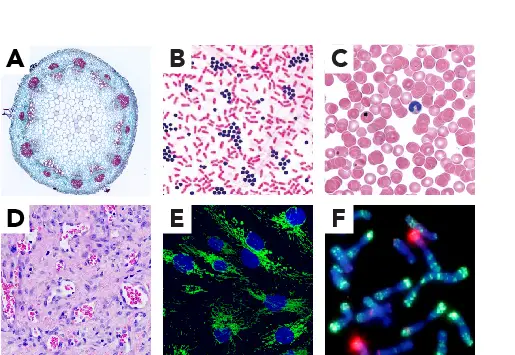
[In this figure]Diverse staining techniques are powerful tools for biological and medical inquiry.
(A) A cross-section of Helianthus Stem stained with Fast Greenish, Congo Red, and Toluidine Blueish. (B) Gram stains to distinguish gram-positive and gram-negative bacteria. (C) Wright-Giemsa staining of a human claret smear to show red blood cells and white claret cells. (D) Hematoxylin and eosin (H&Due east) staining shows blood vessels in mouse tissue. (Eastward) Immunofluorescent staining (IF) of mitochondria (green) in human endothelial cells. (F) in situ hybridization (FISH) of two repetitive sequences on chromosomes of a wild wheat species; Credit: Dr. Pat Heslop-Harrison.
What can I do if I don't have access to standard biological stains?
For amateur microscopy, we may non admission to these new techniques and all kinds of chemicals hands at habitation. Laboratories usually obtain scientific-grade stains from scientific reagent suppliers or microscope specialty stores. However, ordering small quantities from these vendors may not be an economical choice. How can we obtain some basic stains for our habits?
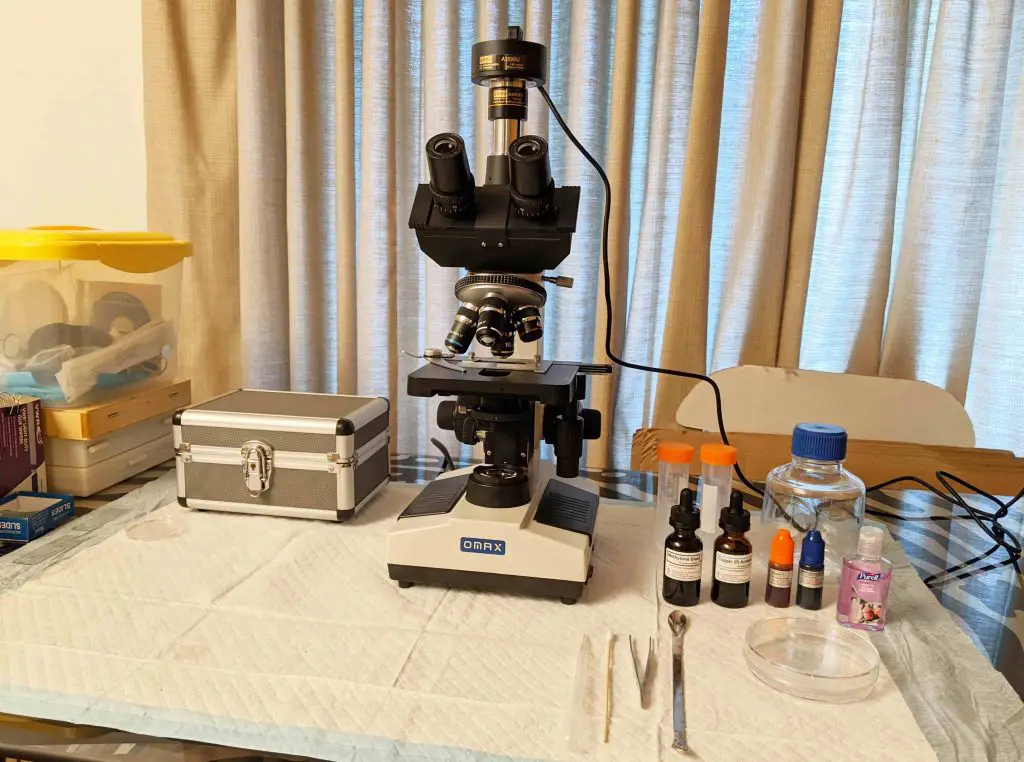
[In this figure]My microscope, tools and several stains
Luckily, some basic biological stains are at present available online. I listing some good choices at the end of this article. In the meantime, I would like to tell you lot some other good news: you lot may already have some everyday items in your firm that can be used as stains!
Methylene blue not only salvage your pet fish but also can stain your DNA
Methylene blue is a popular stain for staining creature cells to make nuclei more visible. Methylene blueish binds DNA which is very abundant in the nucleus. Cells stained by methylene blue show the nuclei with deep blue color. It too helps cells show up against the background, so we tin can see their surround more clearly. The shape of the cells tin can help you determine what they are (their morphology).
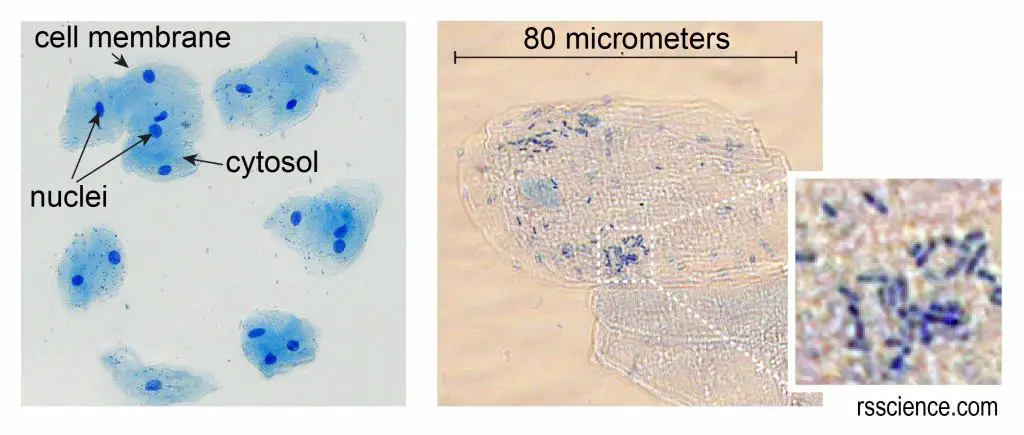
[In this effigy]Check cells stained with Methylene Blue.
The left image is at a lower magnification. Yous can come across the nuclei stained with a dark blue (because Methylene Blue stains strongly with Deoxyribonucleic acid). The cell membrane acts similar a balloon and holds all the parts of a cell, similar a nucleus, cytosol, and organelles within. The right prototype is at a higher magnification. You lot tin too see some pocket-sized rod-shaped bacteria. Don't worry; they are normal oral microbes.
Yous can run across our step-by-step guide to "Wait at your cheek cells".
Methylene blue is commonly used by aquarium hobbyist for treating fishes with fungal diseases. It tin can be purchased from pet stores or online. The concentration of Methylene blue for aquarium medication is effectually two%. We suggest diluting it by add water at 1:1 ratio. This will bring the concentration to 1%, which is standard for biological staining.
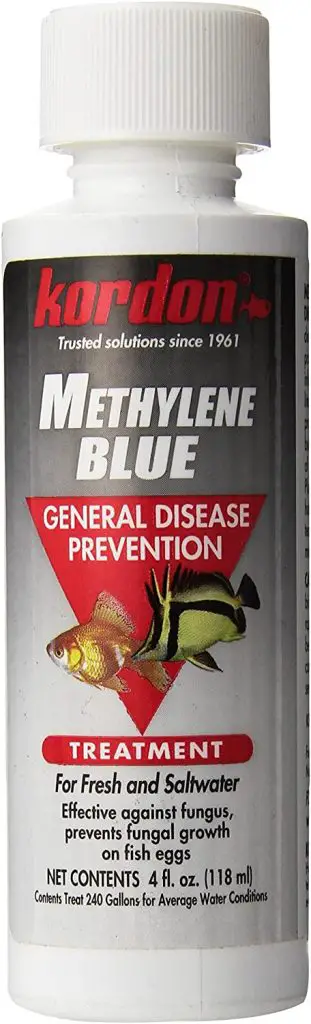
[In this figure]Methylene Bluish for Aquarium.
P.S. a few years ago, there was news maxim that Methylene blue shows hope to reverse aging in human peel. Yet, nosotros do non recommend you lot try that.
Malachite Green turn cells into Emerald gemstones under the microscope
Malachite Green is another mutual item that you tin can obtain from the aquarium store. It is used for treating a parasite disease called ICH (Ichthyophthirius Multifiliis; a species of ciliates) in fish. Malachite Greenish is too a dye with beautiful greenish color and used for fabrics, leather, and paper for centuries.
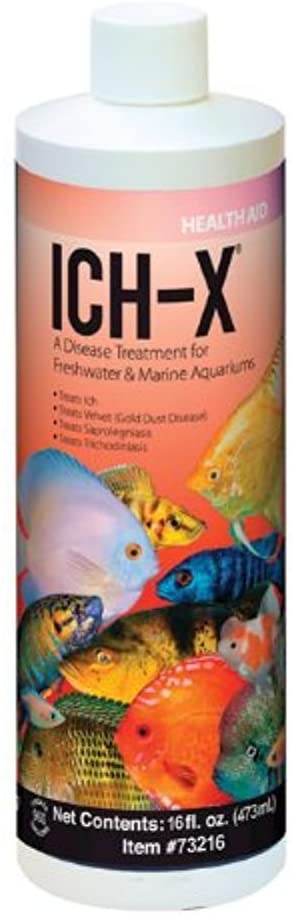
[In this figure]A common ICH treatment containing Malachite Green.
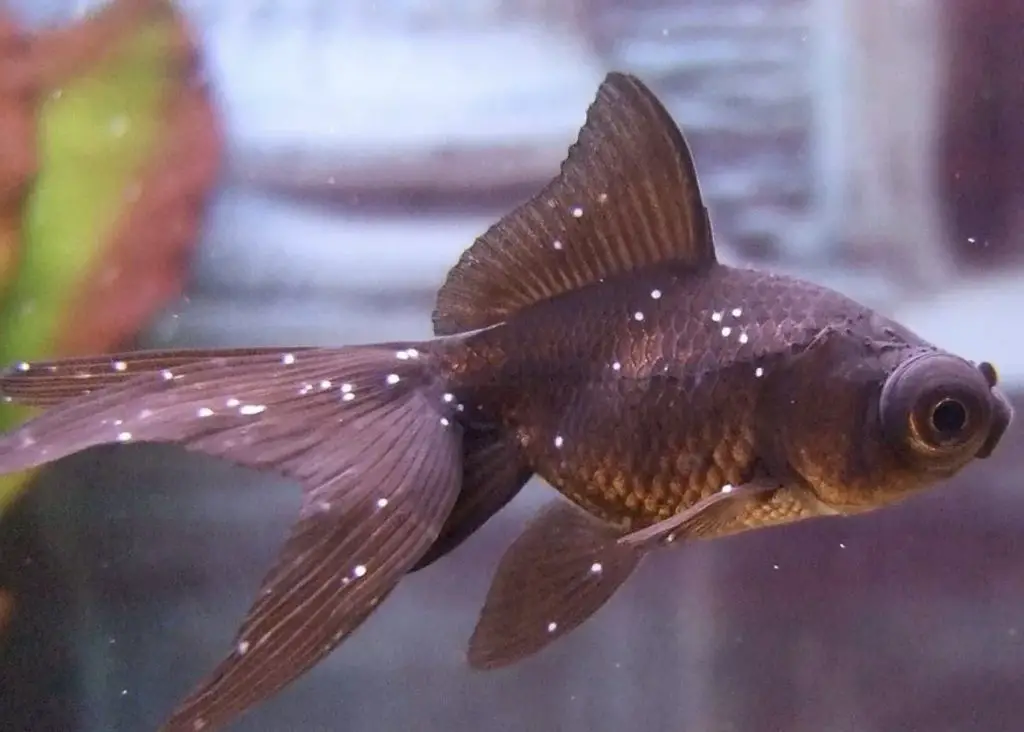
[In this effigy]ICH is a affliction in fish.
ICH (pocket-sized white spots) is caused by the infection of parasites on fish peel. Credit: James Pickett
Malachite Green is a wildly used biological stain for microscopy. For example, Malachite Green can be used as a blue-greenish counterstain to highlight the boundary of leaner and plant cells. Malachite light-green is also used in endospore staining considering it can direct stain endospores within bacterial cells.
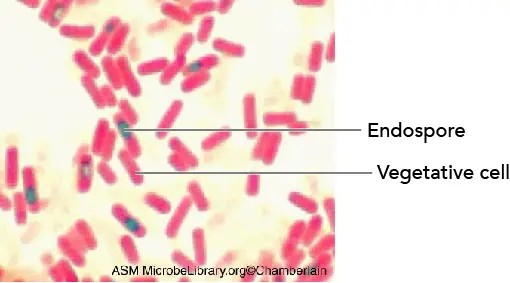
[In this figure]This is a preparation of rod-shaped bacteria called Bacillus subtitles.
Malachite Light-green stains the endospores with green color. Endospores enable bacteria to lie dormant for extended periods, even centuries. Actively growing bacteria (chosen vegetative cells) are stained with Safranin O.
P.Due south. Malachite Green has been frequently used to catch thieves and pilferers past sprinkling the coin bills with Malachite Greenish powder. Anyone handling the labeled money will find that upon washing the hands, a greenish stain on the peel that lasts for several days.
Iodine marks starch
Iodine solution is common for antiseptic (forbid the growth of disease-causing microorganisms). You may already have i or ii bottles of Povidone Iodine in the first aid kit at abode. It can also be purchased over the counter at pharmacies.
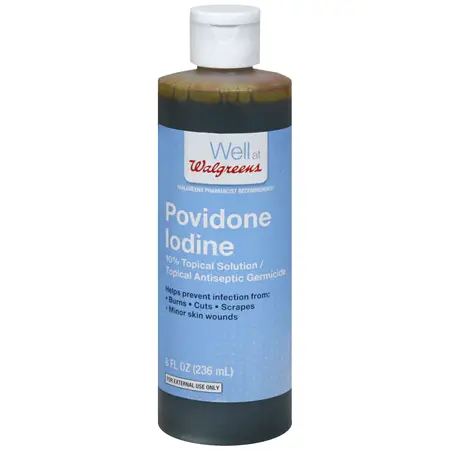
[In this figure] Povidone Iodine solution is a very mutual offset assistance detail.
Platonic iodine concentration for biological staining is 1-two%. Although the bottle says it is ten%, y'all can plow to the content label on the back and you volition see "1% Available Iodine", meaning this Povidone Iodine solution is prepare to utilize for our microscopic staining.
Iodine can be used as a starch indicator. Starch is a type of sugar (or carbohydrate) with long and branching chains. Starch is produced past nearly dark-green plants as energy storage. Depending on the types of plants, starch can be constitute in their leaves, stems, fruits, seeds, and roots.
For case, both white potato and sweet potato are delicious and rich in starch. However, do yous know that they are very dissimilar parts of plants? Murphy is a special thicken type of stems, chosen stem tubers. On the other hand, the part of sweet irish potato we eat is in fact its root, called root tubers. Very surprising, right?
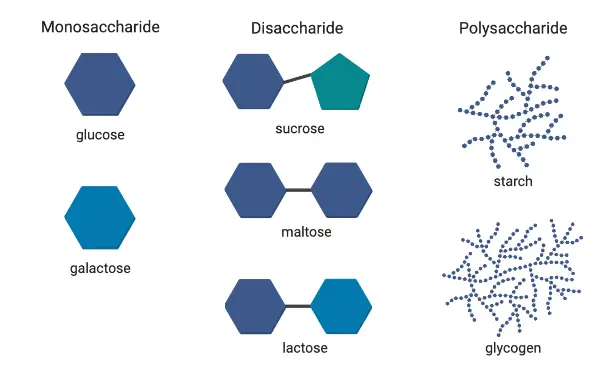
[In this figure] There are ii major types of carbohydrates (or carbs) in foods: unproblematic and complex.
Simple carbohydrates are fabricated of i (monosaccharide) or two (disaccharide) bones sugar units. They are institute in refined sugars, like the white saccharide you run into in a carbohydrate bowl. Complex carbohydrates are long and branch bondage of saccharide units. They tin exist found in plants such equally starch and in animals such as glycogen.
When in solution, iodine tin can react with starch to form regal color. When looking at the iodine-stained specimen, the dense colors indicate the area where the starch is stored.
Iv ways to prepare microscopic slides of plant tissues with your cooking talent
Are you set up to effort iodine (and other) stains? Before that, you need specimens that are thin enough to be able to meet under the microscope. Here are four basic techniques to set up a specimen of plant tissues (Yep, use your cooking talent!):
i. Peeling
You tin can peel off thin layers of tissues from leaves, stems, and onion skins.
2. Slicing
You can use a razor bract (be very conscientious) or a simple handhold microtome to cut sparse sections of plant tissues.
3. Scraping
For spud and sweetness potato, you can cut ane in half and scrape a niggling of the tater (similar a puree) onto the microscopic slide and add together a drop of water. This can be done either with a knife, a spoon or with the fingernails. There should not be any large potato pieces on the drinking glass.
four. Dandy
Yous can smash the root tip of onion into a thin layer of tissue between a microscopic slide and a spoon (be careful not to pause the glass slide). The onion root tip smear is great for staining with iodine (for starch storage visualization) and with Methylene Blue (to run across cells undergo mitosis). The same method tin can also be used in fruits (similar bananas) and seeds (like corn kernels). Soaking seeds in water for a twenty-four hours may be required for some hard seeds.
Other dyes may utilize every bit topical medicines
The following items may not be equally mutual as Methylene blue, Malachite Green, and iodine. Nonetheless, if you happen to have one at home, it could be a useful biological stain.
Gentian Violet
Gentian Violet (too called Crystal Violet) is a key component in Gram stain to distinguish bacteria. Information technology can also stain white blood cells because cherry blood cells exercise not take up the stain. Gentian Violet is sometimes included in the first aid kit as an clarified to prevent fungal infections.

[In this figure] Gentian Violet
Eosin
Eosin is a very useful stain in microscopy and may be used by itself or as function of 1 of the various staining such as Hematoxylin and eosin (H&E). Eosin stains cytosol and certain matrix exterior the cells with pink colour. Eosin (two% water solution) is extensively used in several European countries for diaper rash. Notwithstanding, in the Us, zinc paste is common.
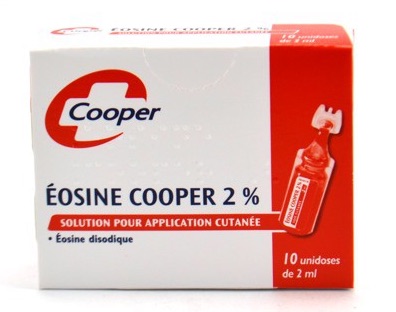
[In this figure] Eosin solution
What makes cupcakes wait delicious can also make your microscopic slides colorful

Be artistic! Nutrient coloring can also exist used for your microscopy hobbit! If you like baking cakes, you probably accept some food coloring additives in your kitchen.
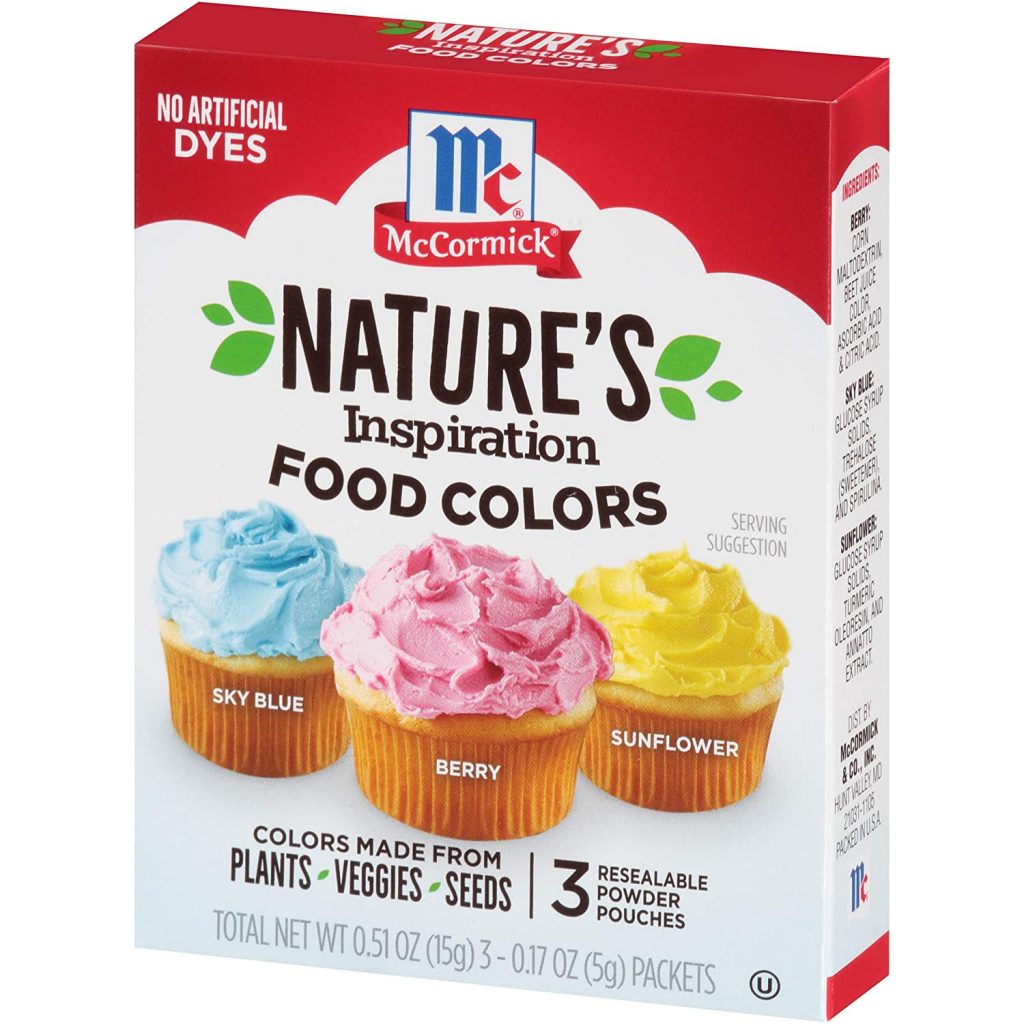
[In this figure] food-coloring dye
Red No. iii (Erythrosine)
Crimson No. 3 (Erythrosine) is a cherry-cherry coloring commonly used in candy and cake, has a property similar to Eosin Y, which gives a counterstain of cytosol.
Greenish No. 3 (Fast Dark-green FCF)
Green No. 3 (Fast Green FCF) stains proteins and can be a adept counterstain for plant tissues.
Blueish No. 1 (Brilliant Bluish)
Bluish No. one (Bright Blue) is the same i used in biochemistry laboratories for measuring protein content. You tin use Brilliant Blue to stains biological samples that are rich in proteins, like bacteria.
Bluish No. 2 (Indigo Carmine or Indigotine)
Blue No. 2 (Indigo Carmine or Indigotine) can exist used to substitute Trypan Blue to distinguish live and dead cells. Healthy cells have intact prison cell membranes to stop Indigo Ruby entering the cells and therefore look unstained. Dead cells are leaky then they will be stained past Indigo Carmine.
Xanthous No.5 (Tartrazine) or Ruddy No. forty (Allura Cherry-red)
Another food coloring like Yellow No. 5 (Tartrazine) or Red No. 40 (Allura Red), may non be that good as a primary stain for cell components. However, you still tin can employ them as a counterstain to add visual contrast, such every bit past providing a groundwork for structures that have taken another color.
P.South. Several food-coloring additives are also pH indicators (mean they change color in acidic or bones solutions). You may like to exam by calculation some vinegar, lemon juice (both are acidic) or baking soda (basic).
You are also encouraged to try all kinds of "natural food coloring" like beetroot juice, saffron, and even matcha! The natural food coloring is nice because it doesn't kill the cells, which is handy and safety for observing transparent pond microlife like Amoebas, rotifers, and ciliates.
Looking for the colorful corner in your study room
Practise non forget your art supplies like inks and watercolors. Although they may not stain specific cell components, y'all still can use them to enhance the contrast as counterstains. Since most biological samples are watery tissues (h2o is accounting for 70% of the weight of our cells), water-based pigments will work improve. Oil paints or acrylic paints may not exist compatible.
Conclusion
Hundreds of years ago, when the microscope was just invented, no one knew how to stain the cells. The scientists tried, experienced, and put what they found in records, and slowly learned the knowledge of biological stains of microscopy.
Now, nosotros probably have hundreds or fifty-fifty thousands of colorful chemicals that tin can be used to written report every aspect in the microscopic wonderland. I want to encourage you to try, just attempt and endeavour, anything you tin can think of. THIS IS THE FIRST Footstep OF Scientific discipline!
Reference
http://www.crscientific.com/microscope-stain.html
http://www.microscopy-u.k..org.great britain/mag/indexmag.html?http://www.microscopy-u.k..org.uk/mag/artmay04/wdstains.html
Related posts
Lesson 2: Mount a Slide & "Expect at Your Cheek Cells"
Lesson 3: Onion Autopsy & "Wait at the Institute Cells"
deeseexierfirs1964.blogspot.com
Source: https://rsscience.com/biological-stains-for-microscope-you-can-find-at-home/
0 Response to "what to check for looking at sperm at home microscope"
Post a Comment