History of the Fingar Family of Germantown, Ny
| Germantown, New York | |
|---|---|
| Town | |
 Town hall, 2013 | |
 Location of Germantown, New York | |
| Coordinates: 42°08′03″Northward 73°52′16″W / 42.13417°North 73.87111°W / 42.13417; -73.87111 Coordinates: 42°08′03″Northward 73°52′16″W / 42.13417°Due north 73.87111°Westward / 42.13417; -73.87111 | |
| Country |  U.s. U.s. |
| Land |  New York New York |
| Canton |  Columbia Columbia |
| Established | 1788 |
| Government | |
| • Type | Boondocks Council |
| • Town Supervisor | Robert Beaury (R) |
| • Town Quango | Members' List
|
| Area | |
| • Total | 13.ix sq mi (36.one kmtwo) |
| • Country | 12.1 sq mi (31.3 kmii) |
| • H2o | one.8 sq mi (4.7 km2) |
| Elevation | 249 ft (76 m) |
| Population (2010) | |
| • Total | 1,954 |
| • Density | 161/sq mi (62.three/km2) |
| Time zone | UTC-5 (Eastern (EST)) |
| • Summer (DST) | UTC-4 (EDT) |
| ZIP code | 12526 |
| Area code(s) | 518 Exchange: 537 |
| FIPS code | 36-28772 |
| GNIS feature ID | 0978998 |
| Website | world wide web |
Germantown is a boondocks in Columbia County, New York, Us. The population was one,954 at the 2010 census.[i] Germantown is located in the southwestern part of the county, forth the east side of the Hudson River.
History [edit]
Early indigenous history [edit]
The expanse currently known equally Germantown was originally occupied by the Mohicans. In the early eighteenth century, Hendrick Aupaumut recorded the movement of his people that had earlier brought them to settle along the rivers that would later be named the Delaware and Hudson. Those who had continued north settled in the valley of the river they named the Mahicannituck (today'southward Hudson River), significant the Waters That Are Never Yet. They named themselves the Muh-he-con-neok later on the river, a name that somewhen evolved to the nowadays day Mohican or Mahican.
The Mohicans settled in the valley, edifice wigwams and longhouses. The river and woodlands were abundant with life and food, which they supplemented with the corn, beans, and squash they grew. Mohican women were usually in charge of this agriculture, along with the homes and children, while men traveled to fish, hunt, or serve as warriors.[two] [3] [4]
Colonization and European-Mohican relations [edit]
In September 1609, Henry Hudson, a trader for the Dutch, sailed up the Mahicannituck. The valley was rich with beavers and otters whose fur the Dutch coveted, and in 1614 a trading post was established. As the fur merchandise expanded, making desired furs harder to find, tensions arose betwixt the Mohicans and the Mohawk, who each sought to maintain their share in the fur trade and relations with European allies. Wars and their furnishings contributed to the loss of Mohican land to the signal where territory in the Hudson Valley dwindled near completely by the end of the seventeenth century. Mohicans were especially affected by European wars such every bit King Philip's State of war where soldiers from Massachusetts and Connecticut attacked Mohicans. In general subsequently war, Mohicans sold land to the Dutch in commutation for needed resources lost in the devastation of indigenous farming and preserved resources. As more and more Europeans arrived and settled on the land, the Mohicans' self-reliance and reliance on the land was eroded past increased dependency on the settlers and their provisions. Settlers began dividing the land, establishing fences and boundary lines. Eventually, the Mohicans were driven from their territory westward of the Mahicannituck and connected to motility further e in the early 1700s.[5]
Robert Livingston, a Scots immigrant, bought thousands of acres from the Native Americans. In 1683, Mohicans sold the offset land parcel along the Roeliff Jansen Impale to Livingstone in exchange for appurtenances likewise as rights to hunting and fishing in the area. While Livingstone received a Mohican deed to the Tachkanick settlement in 1685, then congenital a firm in 1689. These exchanges were the first of a trade relationship that lasted through 1768.[6] He owned a full of 160,240 acres (64,850 ha) at what became Livingston Estate.
Moravian-Mohican relations [edit]
In the summer of 1740, the showtime Moravian mission was established in the Mohican village of Shekomeko. Before that, Moravian missionary Christian Henry Rauch approached ii Mohican leaders, Maumauntissekun (AKA Shabash) and Wassamapah, who were sojourning in New York City. Rauch wanted them to assist bring Christianity to Mohican settlements. Maumauntissekun had a vision in 1739 where he and his Indian brethren laid dead in the woods. Because they suffered from alcoholism, he believed in the demand for religion and temperance. Maumauntissekun agreed to bring Rauch to his town, Shekomeko. Initially, many Mohicans were skeptical of Rauch'south presence because Mohican land had been bought in such great quantities by Europeans. Nevertheless, Maumauntissekun was amidst the offset iii Shekomeko residents to be baptized on Feb xi, 1742. Maumauntissekun then became known every bit Abraham of Shekomeko.[7]
The Moravians lived among Mohicans in Dutchess County and Connecticut's Housatonic Valley. Many Moravians missionaries learned Mohican languages, while oftentimes in areas of strong English language and German influence, they did non. Children of Mohican converts learned to read and write in Moravian schools. Past the mid-eighteenth century, much of Mohican territory was divided by colonial powers, with the private holding of others having displaced traditional communal lands. Although many Mohicans were divided on the new way of life, some adapted to it by converting to Christianity. Families often sent their children to be baptized and raised at Moravian headquarters in Bethlehem, Pennsylvania, due to high bloodshed rates of children from European diseases and war.[8]
In the 1740s in that location were regional Indian raids on European settlements in New York and Massachusetts. Settlers believed that the French in Canada supplied Indians with weapons. Moravian missionaries were perceived as both allies of Canada and Indians, and were defendant of disloyalty for fomenting the uprisings. When Moravian missionaries refused to enter colonial militias in early 1744 the New York colonial government issued a September 1744 order that discontinued Moravian missionary activities in the province.[9]
Mohican-settler state disputes [edit]
In the 1720s, white settlers began to survey Dutchess County country that they claimed according to exchanges originating from the Great Nine Partners Patent. The latter was a landholding of between 8 and 10 miles in width from due east of the Hudson about to Connecticut at the Oblong. Information technology was granted to white settlers in May 1697 and the outcome of negotiations with Indians in eight grants from the Picayune Nine Partners Patent signed in April 1706.[10]
Abraham of Shekomeko (formerly known every bit Maumauntissekun or Shabash) protested the claims simply was notwithstanding willing to sell some state. His grievance was based on Mohican tradition: country that was non used is open for his people to go along hunting and fishing in the area. The Dutchess County territory being surveyed was unoccupied by white settlers for over 4 decades, making European claims de jure. The Mohicans, on the other manus, had been hunting and farming on the state for over two decades. According to a missionary memorandum recorded in 1743, Abraham went to New York City in 1724 where the governor promised to pay for Mohican land and leave them with a square mile for Mohican settlement. In September 1743 that square mile was divided by white settlers. In response, Abraham wrote to the governor disputing the unlawful claims. He tried to testify Mohican ownership past producing witnesses to the Little Nine Partners and fifty-fifty sent a petition around Shekomeko. In the finish, the land was divided, and Abraham moved from the village site while Shekomeko was claimed by a proprietor.[11]
Founding of Germantown [edit]
In 1710, Robert Livingston sold 6,000 acres (2,400 ha) of his property to Anne, Queen of Britain, for use as work camps and resettlement of Palatine German language refugees.[12] Some one,200 persons were settled at work camps to manufacture naval stores and pay off their passage as indentured labor.[xiii] Known every bit "East Military camp", the colony had 4 villages: Hunterstown, Queensbury, Annsbury, and Haysbury.[14] The area was later renamed "Germantown". In 1775 Germantown was formed as a "commune".[15] Germantown was one of the seven original towns of Columbia County established by an act passed March 7, 1788. (The others were: Kinderhook, Canaan, Claverack, Hillsdale, Clermont, and Livingston).[16]
In March 1845, a gunkhole-load of people from E Camp, who had been to Hudson to brand purchases, was run over get-go by a scow, and and then past the steamboat S America. All nine individuals were lost.[17]
Removal [edit]

During the American Revolution the Mohicans supported the colonists but after the war concluded that they were not welcome in the area's villages. The Oneida offered them a portion of country and in the mid-1780s they began to movement to the prayer town of New Stockbridge. Although the customs thrived and the population grew steadily, land companies, hoping to make a profit from the state inhabited by Indigenous communities, proposed that New York Land remove all Native Americans from within its borders. In 1822 agents from New York, missionaries, and commissioners from the War Department negotiated with the Menominee and Ho-Chunk communities of Wisconsin for a tract of land on which to relocate the indigenous tribes of New York. In the following years, members of the community was relocated to Shawano Canton, Wisconsin, and settled on the reservation state.[eighteen] [xix] [20] The modernistic Stockbridge-Munsee Community comprises the descendants of these and other bands and tribes relocated people.
![[icon]](https://upload.wikimedia.org/wikipedia/commons/thumb/1/1c/Wiki_letter_w_cropped.svg/20px-Wiki_letter_w_cropped.svg.png) | This department needs expansion with: This history focuses unduly on the Native American history of the upper Hudson Valley (and in specific that of the Mohican covered thoroughly in its own commodity); further, it stops abruptly with their removal, and contains no boosted content on the community'due south 19th century history, and none any from then to the current date.. You can help by adding to it. (September 2021) |
Geography [edit]
According to the United States Demography Agency, the boondocks has a total surface area of thirteen.9 foursquare miles (36.1 km2), of which 12.one square miles (31.3 km2) is state and 1.8 square miles (4.vii km2), or 13.07%, is water. The western town line, mark the centre of the Hudson River, is the border of Greene and Ulster counties.
Demographics [edit]
| Historical population | |||
|---|---|---|---|
| Census | Pop. | %± | |
| 1820 | 891 | — | |
| 1830 | 967 | 8.5% | |
| 1840 | 969 | 0.2% | |
| 1850 | ane,023 | v.vi% | |
| 1860 | 1,353 | 32.3% | |
| 1870 | ane,393 | iii.0% | |
| 1880 | 1,608 | 15.4% | |
| 1890 | 1,683 | iv.vii% | |
| 1900 | 1,686 | 0.2% | |
| 1910 | 1,649 | −two.two% | |
| 1920 | 1,424 | −13.half dozen% | |
| 1930 | i,462 | ii.7% | |
| 1940 | i,427 | −ii.four% | |
| 1950 | 1,418 | −0.vi% | |
| 1960 | 1,504 | 6.1% | |
| 1970 | 1,782 | 18.5% | |
| 1980 | 1,922 | 7.ix% | |
| 1990 | 2,010 | iv.half-dozen% | |
| 2000 | 2,018 | 0.iv% | |
| 2010 | 1,954 | −3.2% | |
| 2014 (est.) | 1,906 | [21] | −two.5% |
| U.S. Decennial Census[22] | |||
As of the census[23] of 2000, there were two,018 people, 831 households, and 546 families residing in the boondocks. The population density was 166.0 people per square mile (64.ane/km2). There were 984 housing units at an average density of 81.0 per square mile (31.iii/kmtwo). The racial makeup of the town was 96.93% White, 1.14% Black or African American, 0.xv% Native American, 0.45% Asian, 0.40% from other races, and 0.94% from two or more races. Hispanic or Latino of any race were ane.29% of the population.
At that place were 831 households, out of which 28.3% had children under the age of eighteen living with them, 53.seven% were married couples living together, 7.5% had a female person householder with no husband present, and 34.2% were non-families. 28.8% of all households were made up of individuals, and xiv.0% had someone living alone who was 65 years of age or older. The average household size was 2.41 and the average family size was 2.95.
In the town, the population was spread out, with 23.1% under the historic period of eighteen, 6.0% from 18 to 24, 27.ane% from 25 to 44, 25.8% from 45 to 64, and xviii.1% who were 65 years of age or older. The median age was 42 years. For every 100 females, there were 94.iv males. For every 100 females historic period 18 and over, there were 95.5 males.
The median income for a household in the town was $42,195, and the median income for a family was $fifty,885. Males had a median income of $36,806 versus $26,250 for females. The per capita income for the boondocks was $22,198. Nearly v.0% of families and 7.9% of the population were below the poverty line, including 9.3% of those under historic period 18 and v.7% of those historic period 65 or over.
Points of interest [edit]
Germantown Library [edit]
The library was beginning founded in 1948 past the Germantown Garden Club and Emily Finger Lappe in the boondocks hall across from the electric current post office. Information technology was run by volunteers for two years.[24] In 1950, the town hired their start librarian, Bessie Muller-Babcock and she was paid $100 a twelvemonth. When the town hall moved in 1980, the library moved with it until it became apparent that the library had outgrown the space.
In February 2008, the library moved to its new permanent space. This building included dedicated spaces for children, young adults, media, and adults. At the same time, the Hover Room opened to the public for library programs, classes, and town meetings. In 2015, a makerspace area was added to the library, the first of its kind in Columbia County.[25] Iii years later on, the makerspace expanded to meet patron interest and needs. It moved to the lower level, where it occupies half of the floor.
When Covid hit and the library was forced to close its doors, all of their programs went online. Patrons were able to use for and instantly get a library carte online in order to admission materials. Hoopla was added to the range of services the library offers to give patrons more online choices. [26] In improver to Hoopla, the library also offers Kanopy, Overdrive, Libby, Mango Languages, RB Digital Magazines, online Newspapers, and many other things. Gratuitous wifi can be accessed 24/7 and special senior citizen hours are available on Tuesdays and Fridays.[27]
National Register of Celebrated Properties listings [edit]
The Barringer–Overbaugh–Lasher Business firm, Clermont Country Historic Site, Clermont Estates Historic District, Charles H. Coons Farm, Dick House, High german Reformed Sanctity Church Parsonage, Hudson River Heritage Historic District, Rock Jug, and Simeon Rockefeller Firm are listed on the National Annals of Historic Places.[28] [29]
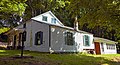
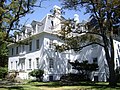


- List of local businesses
- Gaskins
- Otto's Market
- Tousey Winery + Clermont Cafe
- Boating + Line-fishing: two access points to the Hudson River: Cheviot Park off State Rt. 9G and Lasher Memorial Park in North Germantown
- Germantown Library
- Palatine Park (playground, Trivial League + soccer fields, Kellner Customs Activities Center, "Dog Bark" dog park)
- Pop'southward Universe
- Central House B&B
- Gatherwild
Local news sources [edit]
- Rural Intelligence
- The Columbia Paper
Notable people [edit]
- Corbin Bernsen, histrion
- Dow Hover, New York State executioner
- Amanda Pays, actor, interior designer (one of many homes)[30]
- Sonny Rollins, saxophonist
- Oliver Stone, film manager
Communities and locations in Germantown [edit]
- Cheviot – A hamlet about the Hudson River, south of Germantown village.
- Germantown – The hamlet of Germantown is located nearly the Hudson River on Route 9G.
- North Germantown – A hamlet on Route 9G, north of Germantown hamlet.
- Palatine Park – A park northeast of Germantown hamlet.
- Viewmont – A hamlet on the southern town line.
Nearby attractions [edit]
- Bard Higher
- Hudson
- Olana Land Celebrated Site
- Catskill Hiking
- Karma Triyana Dharmachakra, Inc
- Van Alen Firm, Kinderhook, NY
-
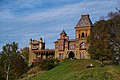
The grounds of Olana are vii miles north of Germantown
-
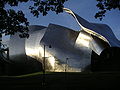
Richard B. Fisher Heart for the Performing Arts at Bard
References [edit]
- ^ "Geographic Identifiers: 2010 Demographic Profile Information (G001): Germantown town, Columbia County, New York". U.S. Census Agency, American Factfinder. Archived from the original on Feb 12, 2020. Retrieved December 10, 2014.
- ^ "Stockbridge-Munsee Band of Mohican Indians". www.mohican.com . Retrieved 2019-11-fifteen .
- ^ Dunn, Shirley W. (Shirley Wiltse), 1928- (1994). The Mohicans and their land, 1609-1730 (1st ed.). Fleischmanns, N.Y.: Purple Mountain Press. ISBN0935796495. OCLC 30473288.
{{cite book}}: CS1 maint: multiple names: authors list (link) - ^ Dunn, Shirley W. (Shirley Wiltse), 1928- (2000). The Mohican earth, 1680-1750 (1st ed.). Fleischmanns, N.Y.: Purple Mount Press. ISBN193009812X. OCLC 44885261.
{{cite book}}: CS1 maint: multiple names: authors listing (link) - ^ Dunn, Shirley W. (Shirley Wiltse), 1928- (2000). The Mohican world, 1680-1750 (1st ed.). Fleischmanns, N.Y.: Imperial Mountain Press. ISBNane-930098-12-X. OCLC 44885261.
{{cite book}}: CS1 maint: multiple names: authors list (link) - ^ Dunn, Shirley W. (Shirley Wiltse), 1928- (2000). The Mohican world, 1680-1750 (1st ed.). Fleischmanns, N.Y.: Purple Mountain Press. ISBNone-930098-12-X. OCLC 44885261.
{{cite book}}: CS1 maint: multiple names: authors list (link) - ^ Dunn, Shirley W. (Shirley Wiltse), 1928- (2000). The Mohican earth, 1680-1750 (1st ed.). Fleischmanns, N.Y.: Purple Mountain Press. ISBNone-930098-12-Ten. OCLC 44885261.
{{cite book}}: CS1 maint: multiple names: authors listing (link) - ^ Dunn, Shirley West. (Shirley Wiltse), 1928- (2000). The Mohican world, 1680-1750 (1st ed.). Fleischmanns, North.Y.: Majestic Mount Press. ISBN1-930098-12-X. OCLC 44885261.
{{cite volume}}: CS1 maint: multiple names: authors list (link) - ^ Dunn, Shirley W. (Shirley Wiltse), 1928- (2000). The Mohican globe, 1680-1750 (1st ed.). Fleischmanns, Due north.Y.: Purple Mountain Printing. ISBNone-930098-12-X. OCLC 44885261.
{{cite book}}: CS1 maint: multiple names: authors list (link) - ^ "The Nine Partners, Dutchess County". www.newyorkroots.org . Retrieved 2019-11-21 .
- ^ Dunn, Shirley W. (Shirley Wiltse), 1928- (2000). The Mohican world, 1680-1750 (1st ed.). Fleischmanns, North.Y.: Purple Mountain Press. ISBN1-930098-12-X. OCLC 44885261.
{{cite book}}: CS1 maint: multiple names: authors list (link) - ^ "About Germantown", Boondocks of Germantown
- ^ Knittle, Walter Allen (1965). Early Eighteenth Century Palatine Emigration. Baltimore: Genealogical Publishing Co. ISBN0-8063-0205-4.
- ^ Otternesss, Philip. Becoming German language: The 1709 Palatine Migration to New York, Chap. 5, Cornell Academy Press, 2013 ISBN 9780801471162
- ^ Ellis, Franklin. Germantown, Columbia Canton, New York, 1878
- ^ "History", Columbia County
- ^ Ellis, Germantown, "Road Districts, 1808". sfn error: no target: CITEREFEllis,_Germantown,_"Road_Districts,_1808" (help)
- ^ Dunn, Shirley West. (Shirley Wiltse), 1928- (1994). The Mohicans and their land, 1609-1730 (1st ed.). Fleischmanns, N.Y.: Majestic Mountain Press. ISBN0935796495. OCLC 30473288.
{{cite volume}}: CS1 maint: multiple names: authors list (link) - ^ Dunn, Shirley W. (Shirley Wiltse), 1928- (2000). The Mohican world, 1680-1750 (1st ed.). Fleischmanns, N.Y.: Purple Mountain Press. ISBN193009812X. OCLC 44885261.
{{cite volume}}: CS1 maint: multiple names: authors listing (link) - ^ "Stockbridge-Munsee Ring of Mohican Indians". world wide web.mohican.com . Retrieved 2019-11-20 .
- ^ "Annual Estimates of the Resident Population for Incorporated Places: April one, 2010 to July 1, 2014". Archived from the original on May 23, 2015. Retrieved June 4, 2015.
- ^ "Census of Population and Housing". Census.gov. Retrieved June 4, 2015.
- ^ "U.Due south. Census website". U.s.a. Demography Bureau. Retrieved 2008-01-31 .
- ^ https://germantownlibrary.org/about/
- ^ https://germantownlibrary.org/well-nigh/
- ^ https://germantownlibrary.org/back up-us/
- ^ https://germantownlibrary.org/elibrary/
- ^ "National Annals Information Organization". National Register of Historic Places. National Park Service. July 9, 2010.
- ^ "National Register of Historic Places Listings". Weekly List of Actions Taken on Properties: 12/01/14 through 12/05/14. National Park Service. 2014-12-12.
- ^ Guralnick, Margot (Dec 30, 2019). "Hollywood on the Hudson: At Home in Upstate, New York, with Amanda Pays and Corbin Bernsen". No. 1. www.remodelista.com. Retrieved one November 2020.
External links [edit]
- Town of Germantown official website
- Germantown Fundamental Schoolhouse District
- Historical information about Germantown
- Germantown Library
deeseexierfirs1964.blogspot.com
Source: https://en.wikipedia.org/wiki/Germantown_%28town%29,_New_York
0 Response to "History of the Fingar Family of Germantown, Ny"
Post a Comment